
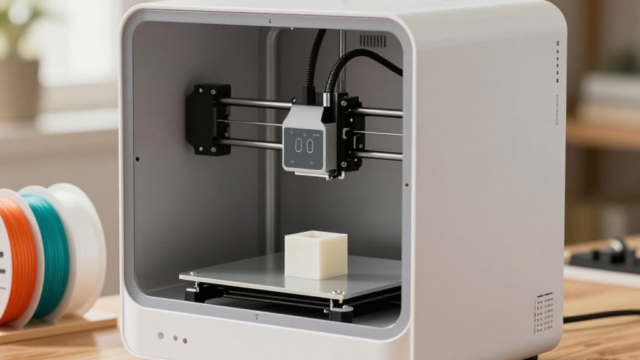
Buying a 3D printer is easy to overthink. There are dozens of models, endless spec sheets, and a wall of acronyms that say little about whether the thing will actually print without constant babysitting. After a few years of running a maker’s bench, here’s how I think about it — and the short list that’s worth your money right now.
Decide what you’re buying for
Before you look at a single spec, settle two questions:
- What will you print? Functional brackets and jigs, hobby figures, big enclosures, or just the occasional bracket for a project. This sets your build volume and material list.
- How much do you value time over money? A printer that “just works” costs more up front but saves you hours of bed levelling and failed prints. For a busy shop, that’s the better deal.
The short list
Budget and reliable — Bambu Lab A1
A1 is the first printer I’d point most people at. It’s a small-format core machine with an auto-calibrated, enclosed-enough build that handles PLA and PETG cleanly, and it’s cheap enough that a second one is a no-brainer. It’s the “I want it to print and not fight me” choice. Build volume is modest, so check it against your largest part before buying.
The sweet spot — Bambu Lab P2S / X2D
Step up to the P2S when you want a bigger volume, a full enclosure, and the AMS (automated multi-colour / multi-material system) without paying X2D money. The X2D is the step up: a faster CoreXY system, an active enclosure, and a dual nozzle in the Combo — it handles ABS, ASA, and other “difficult” plastics that warp and curl on open frames. If you care about finishing or heat-sensitive materials, this is where the money goes.
The open-frame classic — Prusa
If you like tinkering, a Prusa is still the reference for print quality and community support. The trade-off is that it’s an open frame: great for PLA/PETG, not for ABS, and you’ll level the bed yourself. It rewards patience and pays back in the quality and the huge parts/fix ecosystem.
What actually matters in the specs
Ignore the marketing numbers. These three decide whether you’re happy:
- Enclosure vs. open frame — an enclosure is what lets you print ABS, ASA, and nylon. Open frames are fine for PLA and PETG only.
- Heated bed and chamber temp — you need both for anything beyond PLA/PETG. A hot chamber is what stops warping.
- Auto bed levelling and calibration — this is the single biggest time-saver. A printer that calibrates itself is worth the premium over a manual one.
- Build volume — read the three numbers (X/Y/Z in mm) and compare to your largest part, not to a spec sheet’s “biggest number”.
- Filament support — does it take the material you’ll actually use, or just PLA?
The filament question
The printer is only half the equation. PLA is the “learn the machine” material — it prints almost anything with no warping. PETG is your first “strong” material and needs a heated bed. ABS / ASA / nylon need a fully enclosed, heated chamber and they stink — vent the room. Start on PLA and move up as the use case demands.
My recommendation
For most people: Bambu Lab A1 to get printing today, and the P2S as the upgrade once you know what you’re doing. Save the X2D for when you actually need ABS or multi-colour in volume. Buy a printer that removes a step, not one that adds one — the time you save is the real return on the machine.